

Welcome, new board members; Thank you, retiring board members
Welcome to our newest Board of Directors!

(left to right)
Sean Tobin, Jim Walsh, Joe Donaher, Aine Smalley, SIobhan McHugh, Carolyn Wilson Albright, Una McDaid (Executive Director), Brian Tierney, Kerri Donahue Meenagh, Chris Conley, Trish O'Donnell
(not pictured): Sean O'Connell and Judge Jimmy Lynn

Mothers & Daughters Project
Click HERE to sign up and be part of this special project!

Birthright Citizenship
New birthright citizenship executive orders
USCIS updated Policy Manual
USCIS updated its Policy Manual to emphasize that applicants must submit sufficient evidence when filing. The guidance reinforces officers' discretion to deny incomplete or unsupported applications without first issuing an RFE or NOID.
DHS published an interim final rule (IFR) mandating electronic filing of certain immigration forms on August 11, 2026. Effective immediately.
-> Under this IFR, USCIS may require future filings of any immigration form that has been available for e-filing for at least 180 days to be submitted online. USCIS will notify the public on its website at least 60 days before requiring e-filing of a form. Filers must use an online account to submit an immigration form to USCIS, either by completing the form online or by uploading a PDF of the completed form and related evidence.
ICE Arrests Surge at Airports, Opening New Front in Deportation Drive
See AILA travel advisories for green card holders, visa holders and undocumented: Community Alert: Immigration Arrests at Airports - Updated on July 29
TSA Confirm ID program
https://www.tsa.gov/sites/default/files/439_info_tsa_confirmid_3_step.jpg
https://www.tsa.gov/sites/default/files/38_info_tsa-confirm_id.pdf
Alert for Green Card Holders
Green Card Holders and Risks of Traveling After Recent Supreme Court Decision
New Public Charge Rule: File for Adjustment Before Sept. 18, 2026
DHS has finalized its rule rescinding the Biden administration's 2022 public charge regulations that had defined the public charge ground of inadmissibility for the last four years. The rescission will take effect on Sept. 18, 2026, and will apply to adjustment of status applications postmarked or electronically submitted on or after that date. It will also apply to applications for admission at ports of entry. Practitioners are encouraged to file adjustment applications before that date to take advantage of the current public charge definition.
https://pifcoalition.org/toolkits/public-charge-regulation/
https://keepyourbenefits.org/en/na/
https://www.ilrc.org/community-resources/what-you-need-know-now-about-public-charge
https://docs.google.com/document/d/1LZw7fnOOAwViORiLv-K18t3ZaYKPjFko3JEwSVdgUv8/edit?tab=t.0
USCIS Proposed Rule on Naturalization Fees
USCIS has proposed increasing the N-400 filing fee to $1330 for paper filing (up from $760) and $1280 for online filing (up from $710) and eliminating the fee waiver and reduced fee options for naturalization.
This is a proposed rule, meaning it does not go into effect immediately. Public comments are due by August 24, 2026 at 11:59 pm ET.
Here is a basic overview of the proposed changes. To submit a public comment, view this sample template comment. To help drive public comments, use this digital toolkit and refer people to these basic instructions on submitting public comments.
Final Rule on F, J, and I Nonimmigrant Visas Duration of Status
On July 17, 2026, DHS published a final rule establishing a fixed time period of admission and an extension of stay procedures for nonimmigrants in the F, J, and I classifications. DHS previously published an NPRM on Aug. 28, 2025, and the final rule adopts the proposal with amendments. Under this final rule, DHS replaces the "duration of status" (D/S) framework for F, J, and I nonimmigrants with a fixed admission period tied to the program end date or assignment, generally not to exceed four years, followed by a 30- or 60-day departure or extension period. Once that period ends, individuals must file for an Extension of Stay (EOS) directly with USCIS in order to remain in the United States legally. The final rule also transitions procedures for individuals who are currently in the United States under D/S, setting earlier expiration dates tied to program end dates or a four-year cap, plus a grace period. The final rule takes effect on Sept. 15, 2026.
Read more - https://www.dhs.gov/news/2026/07/16/trump-administration-issues-final-rule-end-foreign-student-visa-abuse
On July 30, 2026, the U.S. Department of State issued a Notice of Proposed Rulemaking in the Federal Register to expand and clarify grounds for terminating J-1 exchange visitor program participation, alter extension and reinstatement timelines and tighten compliance standards for sponsors. Sponsors must terminate an exchange visitor if false, incomplete, or fraudulent information/documentation was supplied during the application process or mid-program or for failure to keep mandatory health and accident insurance or engaging in unauthorized employment. Comments due by September 28, 2026.
USCIS Signature Policy Updates
On July 10, 2026, U.S. Citizenship and Immigration Services (USCIS) issued Policy Alert 2026-03, updating its Policy Manual consistent with the interim final rule (IFR) amending USCIS signature regulations which became effective the same day.
For applications filed on or after July 10, 2026, other than Forms N-600 and N-600K, USCIS may assess signature validity at any point in processing. If USCIS accepts a filing and later determines the signature is invalid, the adjudicator may:
Reject the filing and return the fee, particularly where the deficiency is identified early and before significant adjudicative resources are spent; or
Deny the benefit request, retain the filing fee, and treat the application as fully adjudicated.
Read more -- https://www.uscis.gov/sites/default/files/document/policy-manual-updates/20260710-SignatureRequirements.pdf
Open position: Part-Time Community Social Worker
How to Apply: Please send a resume and brief cover letter to jobs@icphila.org with the subject line Part-Time Community Social Worker Application. Applications will be reviewed on a rolling basis.
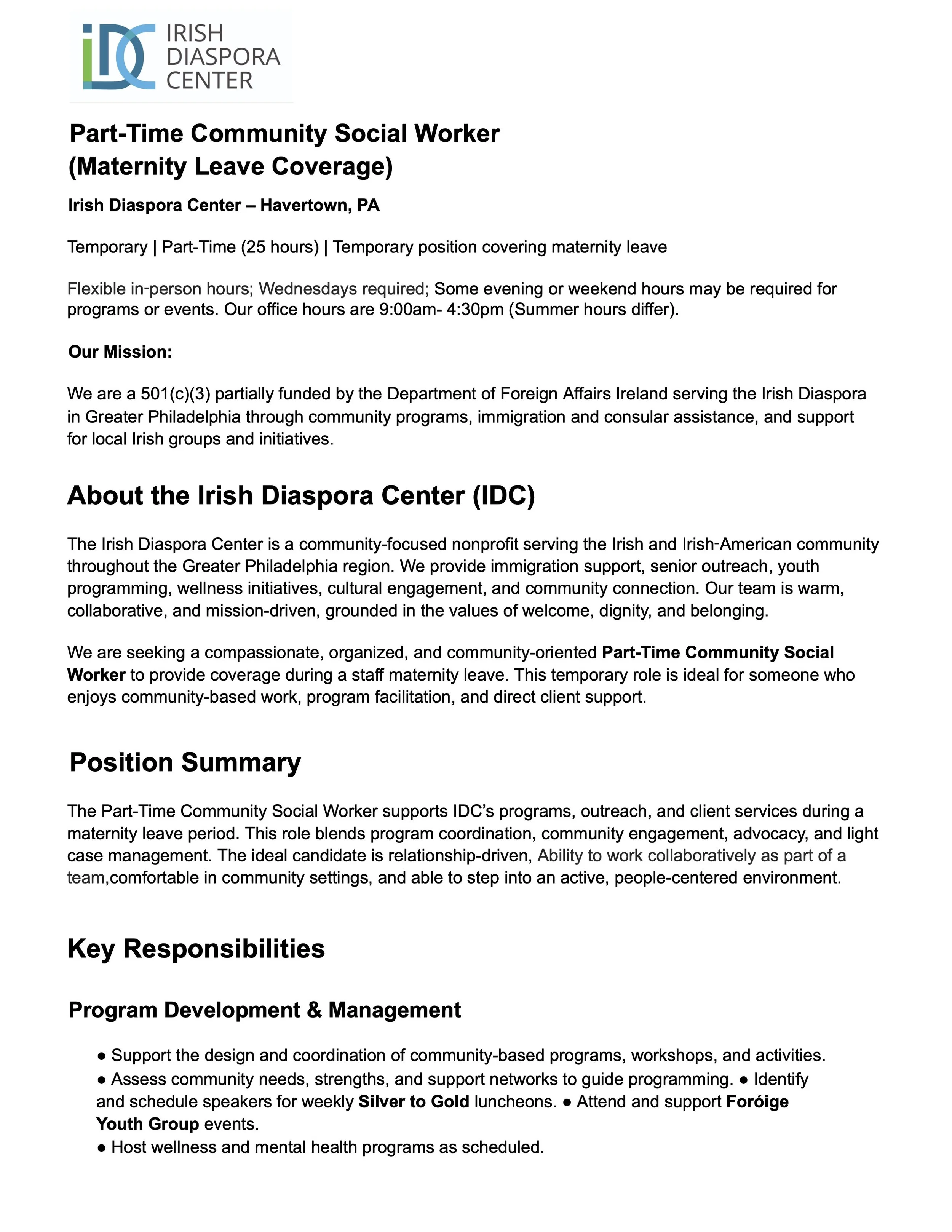
Safe Home Ireland US Tour
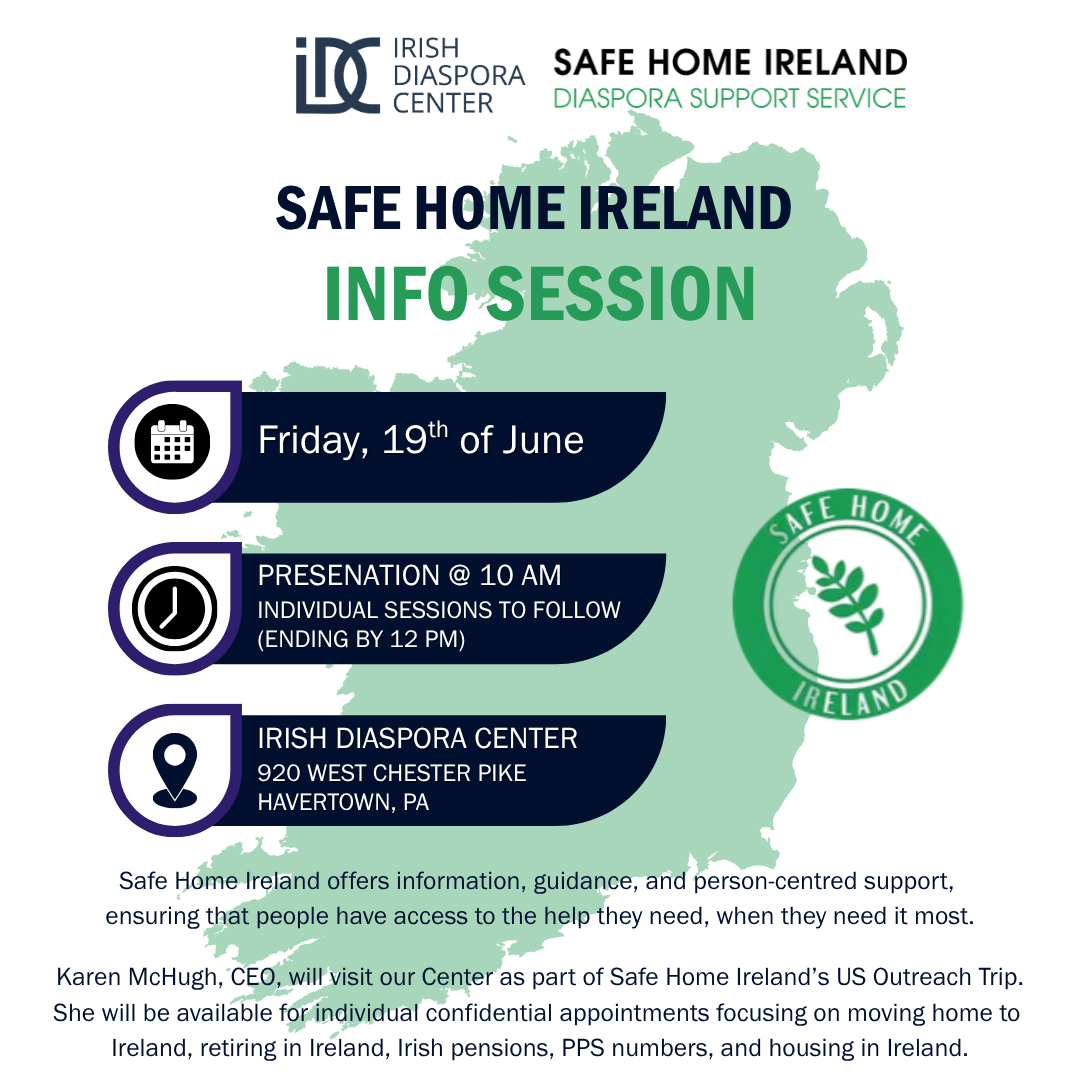
June is Men’s Health Awareness Month
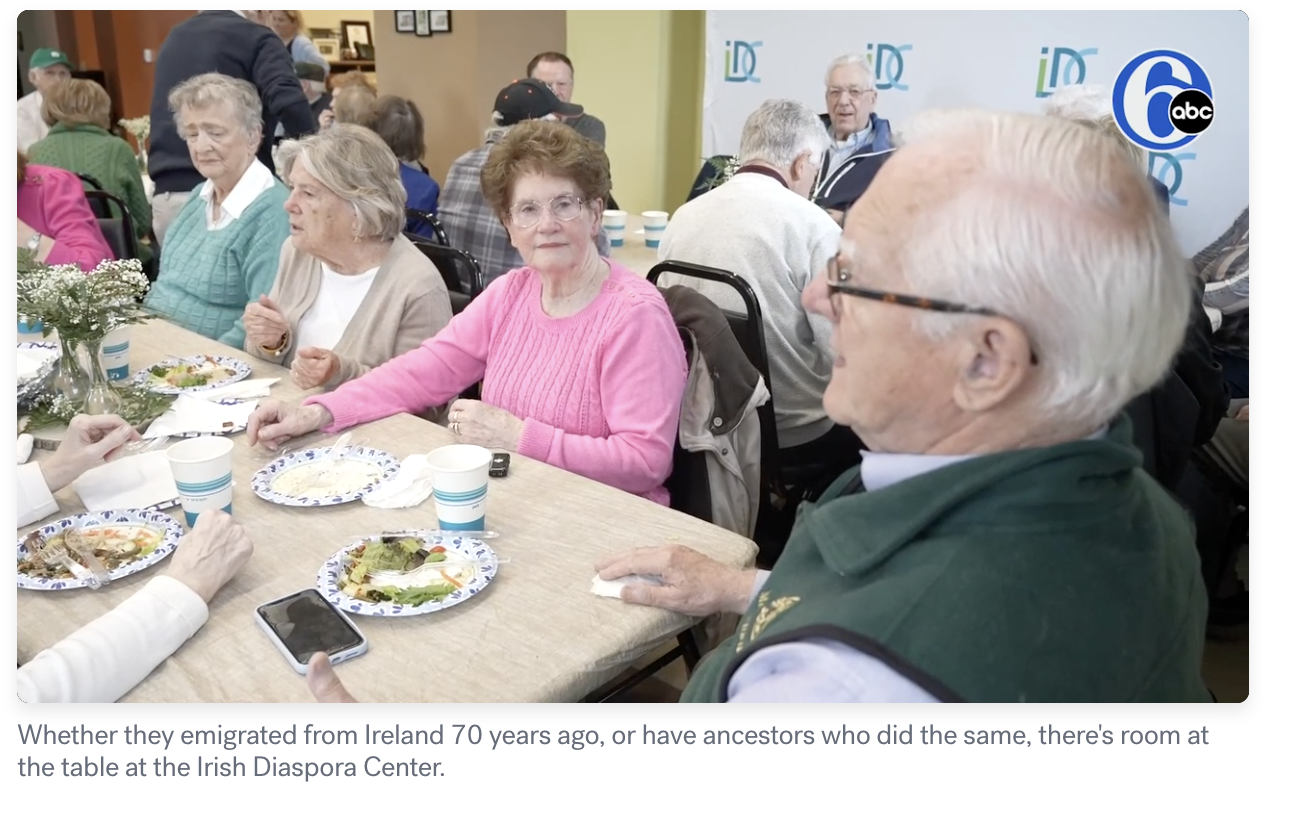
6 ABC: Irish Diaspora Center brings seniors back to their roots in Havertown
IDC Bus Trip
To reserve your place, email info@icphila.org or call 610.789.6355

Mental Health and Motherhood
Mental Health and Motherhood
By Morley McCaul Luciani
April showers have certainly brought some beautiful May flowers! May is such a wonderful time of year, with a focus on celebrating the amazing mothers and women in our lives. Something you may not know, is that May is also Mental Health Awareness Month. I want to take some time this month to acknowledge both mental health and motherhood by discussing Post-Partum Mental Health; this topic is particularly meaningful to me at this point in my life as I await the birth of my first child this summer.
The term “post-partum mental health" is a fairly broad spectrum that is made up of several mental health concerns, such as the post-partum “blues”, post-partum depression (PPD) and post-partum anxiety (PPA). Post-partum blues (often called the “baby blues”) is incredibly common, with nearly 75% of women reporting symptoms, and is often considered a normal part of the post-partum experience. Common symptoms associated with the “baby blues” include feeling sad, irritability, tearfulness and/or minor anxiety; these symptoms often appear within a few hours after giving birth and can persist through the first two weeks of post-partum recovery. Experiencing these symptoms for longer than two weeks, or experiencing more intense symptoms, can be a sign of post-partum depression as opposed to the more common “baby blues”.
In more recent years, advocates have made great strides to raise awareness about post-partum depression, which research shows can affect 15-20% of women in the weeks or months following childbirth. Women suffering from PPD often report having more bad days than good, depressed mood, loss of energy or interest in activities they previously enjoyed, feelings of worthlessness, guilt or incompetence and suicidal thoughts. Some risk factors for PPD include a history of depression or other mood disorders, previously being diagnosed with PPD, limited social support or pregnancy complications, such as a high risk pregnancy. One of the most vital ways to prevent and treat PPD is to know what signs and symptoms are, so that they can be recognized early and addressed by a medical professional right away; it is important for not only the person who has given birth to be aware of PPD symptoms, but also for members of their support system (partner, friends, family) to be able to recognize the signs as well.
Another common post-partum mental health disorder is post-partum anxiety (PPA), which affects roughly 1 in 5 women. PPA is different from post-partum mood disorders as it is marked by an overwhelming feeling of constant danger, worry or discontent rather than depressed mood or persistent sadness; however, you can experience PPD and PPA simultaneously. Some common symptoms of PPA include shortness of breath, restlessness, disturbed sleep, feeling on edge, and/or constant worry about worst case scenarios. People struggling with PPA may experience disturbing intrusive thoughts, may find themselves avoiding public spaces or unable to sleep as they worry about their new baby through the night. Some risk factors for PPA include limited social support, caring for multiple children, or a history of anxiety/panic disorders.
Something that is very important to remember about post-partum mental health is that you are not alone. Many women and parents have experienced one or more of these conditions and there are supports available to help as you navigate through a new and often difficult time. Another important fact to remember is that you are not at fault for struggling as you adjust to being a new parent. Many studies show that one of the biggest contributors to post-partum mental health conditions is the rapid decrease in hormones that occurs in the days and weeks following birth; that change, coupled with lack of sleep and adjusting to new routines can be the perfect storm for mental health challenges and symptoms. As I previously mentioned, it is imperative that all members of a pregnant person’s support system are aware of the signs of post-partum mental health disorders and who to call if they recognize concerning symptoms in their loved ones. As the saying goes, it takes a village to raise a child, and a large part of that village includes supporting parents as they navigate the changes that come with a new baby.
There are many resources in our area that aim to help women and families going through post-partum difficulties. Healthy Minds Philly has a page on their website dedicated to post-partum mental health resources. You can access these resources here: Healthy Minds Philly Post-Partum Resources. As always, I am here as well: to guide you, listen to you and help anyway I can. I am only a phone call, email, or drop in away.
References:
Cleveland Clinic. (2025, August) Postpartum Anxiety. https://my.clevelandclinic.org/health/diseases/22693-postpartum-anxiety
Cleveland Clinic. (2026, March). Postpartum Depression. https://my.clevelandclinic.org/health/diseases/9312-postpartum-depression
Policy Center for Maternal Mental Health. (2025, May). Maternal Mental Health[Fact Sheet]. https://policycentermmh.org/maternal-mental-health-fact-sheet/